The short answer
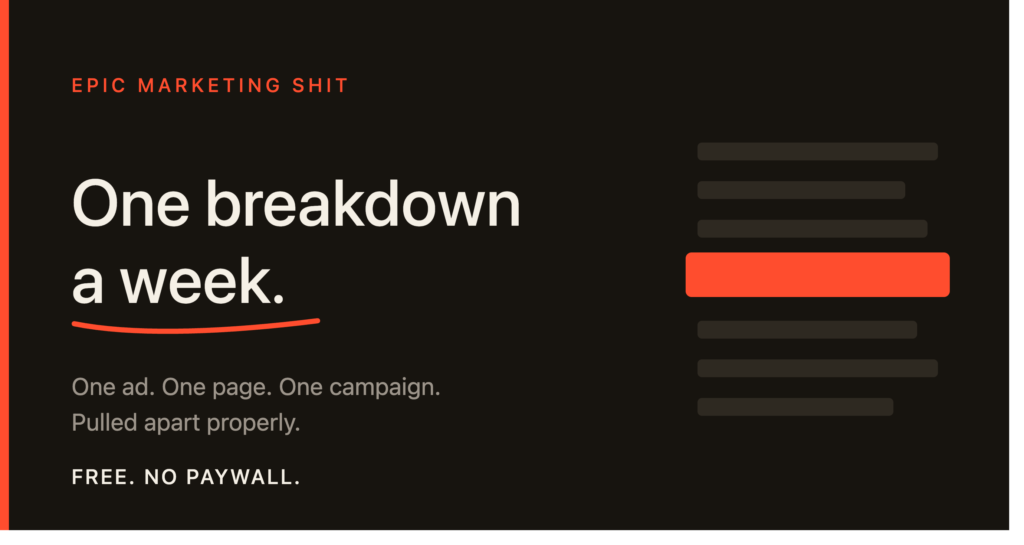
Epic Marketing Shit is a free marketing newsletter that sends one breakdown a week — a single ad, piece of copy, or campaign pulled apart to show why it works. No paid tier, no paywalled archive, no link dumps. Free means free: you get the whole thing, permanently, and you can leave in one click.
Key takeaways
- One thing per week, properly examined. Not a news digest, not ten links with a sentence each.
- Free with no paid tier. Nothing is held back for a premium version, because there isn’t one.
- Independent. Not on Substack or any platform that recommends other newsletters to you inside your own inbox.
- Written by a person, not a brand. Somy D., every edition, every sign-off.
- Plain English, short sentences. Written the way people talk, not the way marketing usually gets written.
- One click to leave. No dark patterns, no “are you sure,” no downgrade flow.
What “free” actually means here
Worth being specific, because “free” gets used loosely.
Some free newsletters are trials. Three good issues, then a paywall right at the interesting part. Some are permanently free but hollow — the real material lives behind a paid tier and the free edition is an advert for it. Some are free because they cost nothing to write, which you can feel by the second paragraph.
Epic Marketing Shit is free in the boring sense. There’s one version. Everybody gets it. There is no premium edition, no gated archive, no members’ area, and no upgrade prompt at the bottom of the email.
So how does it work? Newsletters like this are usually funded one of three ways: a sponsor slot, the writer’s own business, or nothing at all. This one exists because writing breakdowns is how I think about marketing, and I’d be doing it anyway. If a sponsor slot ever appears it’ll be one, clearly marked, and the breakdown won’t change to accommodate it.
That’s the whole arrangement. You give up an inbox slot. You get a breakdown a week.
What you actually get
One edition, once a week. Each one takes a single thing and pulls it apart.
That thing might be a landing page that’s converting well and shouldn’t be. An ad that everyone shared without noticing why. A subject line doing more work than the email under it. A campaign that flopped for a reason nobody named. A piece of packaging copy. A pricing page. A billboard.
The structure doesn’t vary much:
Here’s the thing. Shown, not described. Here’s what it’s doing. The mechanism, named plainly. Here’s why it works. Or why it doesn’t, which is often more useful. Here’s where you’d use it. So you leave with something, not just an opinion.
No news roundup. No “5 trends to watch.” No recap of last week’s edition. No three-paragraph windup before the point.
It takes about four minutes to read. It should leave you with one mechanism you didn’t have before.
Who it’s for
People who like marketing — not people who like marketing content. There’s a difference, and it shows up fast.
More specifically: copywriters who want to see how other people’s copy is built. Marketers who are tired of advice written in the passive voice by nobody in particular. CMOs who want the reasoning rather than the recap. Founders doing their own marketing who need mechanisms more than they need frameworks.
Who it isn’t for
Being honest here saves us both time.
If you want industry news, this isn’t it. It won’t tell you what Google shipped this week or which agency merged with which. You’d need a daily news source alongside it, and that’s a fair thing to want.
If you want daily, this isn’t it. One send a week. That’s on purpose, but if you like a morning briefing habit, this won’t scratch it.
If corporate tone matters to you, this isn’t it. The name is Epic Marketing Shit. It’s casual, it’s blunt, and it swears occasionally. Plenty of good people would rather it didn’t, and they should subscribe to something else.
If you want a big archive to dig through, it’s a younger newsletter than most. That’ll change, but it hasn’t yet.
What happens when you sign up
No surprises, and no dark patterns.
You’ll get a confirmation email. Click the link — that’s double opt-in, and it’s the reason the newsletter actually lands rather than rotting in spam.
The first edition arrives on the next send day. No 12-part onboarding sequence, no welcome funnel, no automated “quick question — what’s your biggest marketing challenge?” email.
Your address doesn’t go anywhere. Not sold, not rented, not passed to a sponsor. It sits in the sending platform and receives one email a week.
Leaving takes one click. Unsubscribe link at the bottom of every edition. No confirmation page, no “are you sure,” no offer to reduce frequency instead. If it’s not for you, go.
One practical tip: if the first edition lands in Gmail’s Promotions tab, drag it to Primary and reply to it once. Gmail treats a reply as a strong signal, and doing this on the first email works far better than trying to fix it three months later.
Free vs paid marketing newsletters
A fair question if you’re deciding where your reading time goes.
Paid newsletters earn their money in three situations: proprietary research nobody else has, access to a community of operators in your exact position, or a deep searchable archive you’ll genuinely use. Those are real reasons to pay.
Everything else — tactics, teardowns, frameworks, opinions, industry news — is available free at high quality. The category is competitive enough that paying for it is usually a preference rather than a necessity.
The sensible order is: build a free stack of two or three newsletters, read them for a couple of months, and only pay when a specific gap becomes obvious. Paying first and hoping the habit follows almost never works.
FAQs
Is Epic Marketing Shit really free? Yes. There’s one version and everyone gets it. No paid tier, no gated archive, no premium edition, no upgrade prompts. You give up an inbox slot and get one marketing breakdown a week in return.
How often does the newsletter send? Once a week. One edition, one breakdown, about four minutes to read. There’s no daily option and no plan for one — the whole point is depth on a single thing rather than coverage of everything.
What’s in each edition? One ad, landing page, campaign, or piece of copy, pulled apart. What it’s doing, why it works, and where you’d use the same mechanism. No news roundups, no link dumps, no trend lists.
How do free marketing newsletters make money? Usually through sponsor slots, or by acting as top-of-funnel for the writer’s own business. Some make nothing at all. It matters less than people think — what matters is whether the free edition is complete or a teaser for something paid.
Will I get spammed if I sign up? No. One email a week, no sequences, no sales funnels, and your address isn’t sold or shared. The unsubscribe link is at the bottom of every edition and it works in one click.
Do I need to be an experienced marketer to get value from it? No. Breakdowns explain the mechanism rather than assuming you already know it. Beginners get a way of looking at marketing; experienced marketers get examples and language for things they half-knew already.
Is it a copywriting newsletter or a marketing newsletter? Both, honestly. Most editions look at copy because copy is where the mechanism is usually visible, but the subject matter runs across campaigns, positioning, packaging, and pricing too.
Why isn’t it on Substack? It runs independently. Platform newsletters get other people’s newsletters recommended inside them, which is a strange thing to do to your own readers. Independent means the only thing in the email is the email.
Subscribe
One breakdown a week. One ad, one piece of copy, or one campaign — pulled apart properly, in plain English, with no filler and no paywall.
Free. Unsubscribe whenever you like.
~ Somy
0 Comments